
The Path Integral is our fourth release.
It’s an ambient / electronic EP about infinite paths and how we choose one.
Listen here.
The Path Integral is our fourth release.
It’s an ambient / electronic EP about infinite paths and how we choose one.
Listen here.

Primes is our third release.
It’s a 30-minute sonic investigation into the distribution of prime numbers.
Listen here.

The Boundless is our second release.
The source of inspiration for the entire work is the oldest surviving fragment of all Western philosophy, from the thought of the greek philosopher Anaximander. It’s – in our opinion – a quite impacting fistful of words about guilt, justice, necessity, time and – ultimately – existence.
Listen here.
○ Mar 2026 | Label: Passed Recordings
■ Genres: Drone / Ambient
■ Rating: 8.0/10
■ Favorite track: “Grand Prismatic Spring”
► This unfolds like the slow arrival of an inescapable storm, its atmosphere thick with anticipation and dread. Low, sustained tones gather like dark clouds, gradually intensifying as subtle dissonances ripple beneath the surface. Textures swell and shift like distant thunder, hinting at something immense and unavoidable. There is no refuge within the sound — only immersion in its looming presence.
○ Feb 2026 | Label: Independent
■ Genres: Ambient / Field Recordings
■ Rating: 7.7/10
■ Favorite track: “illusionary world”
► This centers on a four-note phrase loop that circles gently over a sustained harmonic bed, creating a sense of quiet persistence. The guitar tone is clean and luminous, while delayed sounds scatter outward, falling like droplets across the stereo field. These echoes add depth and motion, transforming a simple motif into a richly textured space. The interplay between repetition and decay feels organic, as if the sound were breathing. Meanwhile, people talk, traffic persists, but music – just like life – continues to flow.

[1. IDEA]
■ The A. O.: The track from “A Small Life and Unnoticed Movements” that we prefer is “Small Body”. Can you tell us how it came to light?
► Giacomo Vanelli & Matteo Cantaluppi: Through six musical pieces and six short films created together with filmmaker Fausto Caviglia, we wanted to create a space for slow listening and attentive looking, where sound and image invite the viewer to observe the world at a different pace.
[2. CREATION]
(more…)○ Nov 2025 | Label: FORM@ RECORDS
■ Genres: Electronic / Ambient
■ Rating: 8.4/10
■ Favorite track: “Echoes of the Long Night”
► This blossoms around an airy piano phrase loop, which repeats with quiet insistence at the heart of the piece. Surrounding it is a superb electronic texture — rich, layered, and slowly evolving — like a soft halo of sound expanding outward. The result is immersive and emotionally resonant, balancing clarity and abstraction. It’s a greatly sculpted soundscape where a simple piano idea grows into a luminous, enveloping ambient journey.

[1. IDEA]
■ The A. O.: The track from “El Dolor La Norma” that we prefer is “S’Agabbadòra (Mazzolu)”. Can you tell us how it came to light?
► thëm: The concept of ‘El Dolor La Norma’ arose after suffering from a serious and rare illness, which fortunately is now in the past. It left me with several bad and somewhat traumatic experiences on a personal level. After a while, they were still very present in my daily life, dark and sad memories. I thought it might be therapeutic/healing to use these feelings to do something beautiful and enriching for myself. And then I expanded the concept of the album to explain stories that, at first glance, seem cruel but turn out to be healing or kind. While searching for information about this concept in other cultures, I came across S’Agabbadòra, a woman who was responsible for providing a quick death to terminally ill patients so that they would not suffer. I thought she was a clear example of the concept of the album, as she may seem like a macabre, cruel character, but she was actually a person who was called upon by the relatives of the terminally ill to end their suffering. Meanwhile, Mother Teresa of Calcutta, a figure associated with kindness, had her “hospitals of suffering”/’houses of death’, where, through the privacy of medicine and the pain suffered by the sick until their agonising death, she promised them paradise (the more you suffer, the greater the reward). Agabbadòra bad and Mother Teresa good… isn’t that curious?
The song attempts to set to music the scene of how I imagine it would be before, during and after S’Agabbadòra’s work with a patient.
[2. CREATION]
(more…)
[1. IDEA]
■ The A. O.: The track from “Loop Drawing” that we prefer is “A Shower of Light”. Can you tell us how it came out?
► Hajime Nakamura: I imported several stems I had been working on into DJ software, then adjusted the pitch and applied various effects while shaping the track. That’s how the piece came together.
[2. CREATION]
(more…)○ Feb 2026 | Label: Independent
■ Genres: Ambient / Electronic
■ Rating: 7.1/10
■ Favorite track: “No Man Has Ever Died Beside A Sleeping Dog”
► This unfolds like a slow, unsuccessful escape attempt. Quiet tension and shifting textures suggest movement forward, yet something unseen seems to resist every step. Layers of synths gradually expand and darken, creating an atmosphere that feels both spacious and confining. The progression is patient, almost hesitant, as motifs appear and dissolve without resolution. Each sonic change hints at possibility, but the destination remains unreachable. Hope and frustration coexist.
○ Feb 2026 | Label: See Blue Audio
■ Genres: Ambient / Electronic
■ Rating: 8.5/10
■ Favorite track: “Theory of Change Pt 2 (Remastered)”
► This unfolds with quiet and mysterious elegance. The track moves effortlessly through the nuances of a ternary musical phrase that serves as its guiding motif. Texture and tone gradually reveal new shades of emotion with each cycle. The structure becomes a space for exploration, where rare layered synths and delicate timbral variations expand the idea to its fullest potential. A great minimalist work.
○ Dec 2025 | Label: Passed Recordings
■ Genres: Ambient / Drone / Electronic
■ Rating: 6.9/10
■ Favorite track: “Winterlude”
► This floats effortlessly within an airy, expansive atmosphere. Soft synth plucks drift in gentle layers, creating a sense of open space where each tone has room to breathe. Subtle harmonic shifts and delicate textural details add quiet movement, preventing the sound from ever feeling static. There’s a soothing clarity to the production, as if light were filtering through sound itself. Everything is weightless and luminous.

[1. IDEA]
■ The A. O.: The track from “Unfurling” that we prefer is “My breath the sea”. Can you tell us how it came to light?
► Pefkin: I read a book by the Scottish historian Alistair Moffat a few years ago called “In Search of the Saints” which is about the Irish saints who travelled to the Scottish west coast and islands to spread Christianity and find solitude, the most famous being Columba who established a religious community on Iona which stills exists. I’ve wanted to go and visit the beehive cells on the uninhabited Garvellach islands in which some of these monks would meditate in solitude. I’ve not managed to do that so I did the next best thing and wrote a song about it, imagining the passage through the seasons, the loneliness, the winter storms, the trance state, feeling disembodied and fearful. The protagonist in the song no longer knows if he hears his breath or the sea as he prays and meditates in the depths of a winter storm.
[2. CREATION]
(more…)○ Feb 2026 | Label: Independent
■ Genres: Electronic / Ambient
■ Rating: 7.0/10
■ Favorite track: “Arms Used to Hold You”
► This is really a little precious gem. The gentle imperfections of an old piano become part of a touching language. The delicate V–I cadence anchors the piece with a quiet sense of resolution, repeating like a soft, familiar breath. Around it, subtle electronic fragments flicker and drift — glitches, faint textures, distant tonal echoes — adding movement without disturbing the fragile calm. Listen and try.

[1. IDEA]
■ The A. O.: Can you tell us how the the track “Nova Mistero” came to light?
► virabelo: Nova Mistero (which is Esperanto for ‘New Mystery’) happens to be the sister track of Monolito (‘Monolith’). The two tracks share the same synthesis approach while also being the same total track length, which wasn’t hard to end up that way as they both share the same 60 bpm tempo. While Monolito is much darker in mood, I found that Nova Mistero has a much more lighter and open feel. Originally, the album was going to be called Monolito, with the album’s title track being the final track on the album. After later composing and naming the Nova Mistero track, I found that the track title sounded much nicer for the album name, and also felt the overall vibe of it was perfect to begin the album while the sister track, Monolito, closes the album.
[2. CREATION]
(more…)○ Jan 2026 | Label: Shady Ridge Records
■ Genres: Ambient / Drone
■ Rating: 8.5/10
■ Favorite track: “Wait For Me”
► This evolves in broad, patient movements, with layers of electric guitars drifting like slow, rolling waves. Each line melts into the next, forming a dense yet fluid sound mass that feels both expansive and intimate. Sighs of light tension, sustained tones and gentle feedback create a sense of endless motion, as if the music were breathing at its own pace. There’s a quiet emotional pull in the repetition, a feeling of calm tinged with longing. The track resists dramatic shifts, instead embracing gradual transformation.
○ Aug 2025 | Label: Independent
■ Genres: Experimental / Ambient / Post-rock
■ Rating: 7.4/10
■ Favorite track: “S’Agabbadòra (Mazzolu)”
► This ambient / post-rock track builds a vast, immersive atmosphere. That’s done by layering shimmering electric guitars over slow, pulsing bass lines, all carried by a hypnotic three-note synth arpeggio. The arpeggio acts as a steady current, allowing the guitars to swell, recede, and intertwine like waves of sound. Patient and expansive, the track unfolds with cinematic grace, offering a powerful blend of repetition and evolution that invites deep, focused listening.

[1. IDEA]
■ The A. O.: The track from “Cartography of Sleep” that we prefer is “Catastrophic”. Can you tell us how it came to light?
► Droning Cats with NRV: Catastrophic emerged the way much of this album did: in an unplanned moment where intuition quietly leads the way.
During one of our sessions in Brussels, a cluster of bird-like modular tones appeared almost out of nowhere, hovering over a deep, grounding drone. It felt like stepping into a dreamscape — familiar yet shifting. Christophe’s guitar responded instinctively, tracing a melodic path through this fragile sonic terrain.
As with the entire album, the recording was then sent across the world to NRV in Japan, who expanded the space with his subtle atmospheric signature—pads, reverbs, a softened horizon that allowed the track to breathe and unfold.
It’s worth noting that Cartography of Sleep was created entirely at a distance. Although Droning Cats and NRV have never met in person, the collaboration formed a kind of long-distance resonance: Brussels and Japan connected through sound, intuition and shared sensibility.
The title Catastrophic was given by Christophe’s ten-year-old son—a spontaneous suggestion that captured both innocence and emotional scale. We kept it immediately.
[2. CREATION]
(more…)○ Jan 2026 | Label: Ingrown Records
■ Genres: Ambient / Electronic
■ Rating: 7.8/10
■ Favorite track: “A Shower of Light”
► This ambient electronic track unfolds around a dreamy atmospheric loop. The sound design feels light and immersive, as if floating through a half-remembered landscape. Nothing rushes: each element breathes and dissolves naturally. It’s an introspective, soothing piece that rewards attentive listening while remaining inviting as a background companion. A delicate, serene composition where repetition becomes hypnotic and atmosphere takes center stage.

[1. IDEA]
■ The A. O.: The track from “Dwam” that we prefer is “Inbound”. Can you tell us how it came to light?
► Tó Anjo: This is the track that really got the album process going for me, and since its inception it felt like an opener. There’s the sound of a train arriving at a station and people stepping out on the platform which kind of divides the track in its two sections and this, along with the title of the song, really ties everything into the theme of arriving somewhere and starting something new. Most of the tracks came after this idea and as a continuation of this sound.
[2. CREATION]
(more…)○ Jan 2026 | Label: Morc records
■ Genres: Ambient / Drone / Experimental
■ Rating: 8.1/10
■ Favorite track: “My breath the sea”
► This is immersive and solemn, balancing reverence and unease. A slow bass pulse that feels both sublime and tense grounds the piece in a ritualistic sense of anticipation, while a whispered voice with a sacral tone weaves through the texture like an invocation. Notes from strings rise and fade in restrained gestures, intertwining with fractured electronic fragments that shimmer and decay at the edges. That’s such a powerful and deeply absorbing work in its slow, deliberate intensity.

[1. IDEA]
■ The A. O.: The track from “Atlas” that we prefer is “Desert Plain”. Can you tell us how it came to light?
► Perry Frank: Desert Plain was written and recorded during an evening session together with Leave No Shadows On The Ground.
They were basically written with guitar, while making experiments with reverb and delay pedals on my pedalboard after watching a documentary about the Amazon deforestation.
Main drones features a combination of the Strymon Cloudburst and the Hologram Electronics then I’ve added a bass line with the Volcakeys.
Basically there are only three or four tracks in this song.
I usually record my songs on tape cassettes with my Fostex X18 multitrack, often when they feature not so much tracks, then I record the tape on my Mac.
Titles came to me while thinking about a future when all the trees have been cut down, all around there will be only desert with no shadows on the ground.
[2. CREATION]
(more…)During this first year of activity we’ve sifted through countless independent releases, following faint signals rather than hype.
These 10 tracks stood out not for volume, but for intent. They move between ambient drift, instrumental focus, electronic tension, contemporary composition and experimental minimalism, often blurring those lines entirely. What connects them is a shared patience: sounds are allowed to breathe, structures either unfold or fall slowly, ideas trust the listener.
Together, they form a small map of the year’s most compelling independent music — works that reward attention and linger well after the final note fades.
Here is a mix set of all tracks (click on each track link for more info) ▼
See you in 2026.
○ Dec 2025 | Label: Independent
■ Genres: Drone / Ambient
■ Rating: 7.3/10
■ Favorite track: “Nova Mistero”
► Here’s a vessel for elevation and release. Sustained tones drift freely, unmoored from rhythm or structure, giving the listener a sensation of endless suspension. The sound is airy and expansive, yet this very openness carries a subtle anxiety — there’s no clear anchor, no ground to return to. That’s both soothing and unsettling, capturing the paradox of freedom without support. Yet we surrender to weightlessness.

[1. IDEA]
■ The A. O.: The track from “Never started never ended” that we prefer is “5 steps”. Can you tell us how it came to light?
► RAUSTE: I needed to close my EP, and I wanted to end it with a positive note especially because the rest of the EP is quite dark in the way it was conceived. I needed some hope. I remembered an old video I took of my son, who was 4 years old at the time, playing the piano for the very first time: 5 notes, 5 movements, 5 steps to a new world. (Fun fact: today, years later, that world completely belongs to him.)
The melody was already there; I just needed to shape it the way I liked by creating different samples, working on pitch, reverse effects, and so on.
The final touch, the element that gives the sequence its unity, is the sampled birds and wind chimes. For this, I have to thank the artist Lonetapes, who kindly shared these sounds with the whole community.
[2. CREATION]
(more…)○ Dec 2025 | Label: See Blue Audio
■ Genres: Ambient / Post-rock / Electronic
■ Rating: 8.4/10
■ Favorite track: “Catastrophic”
► Well, you’d better take 5 minutes of your time for this track. Guitar lines slowly evolve within a sea of spacious, enveloping layers of atmosphere. Sun is quietly rising all around. The progression is patient and immersive, inviting the listener to sink fully into the sound. Each swell adds depth and scale, transforming simple phrases into something vast and cinematic. Resistance is futile.

[1. IDEA]
■ The A. O.: Can you tell us how the track “Misty Lake” came to light?
► H-M O: I live in northern Finland and spend a lot of time in nature – one beautiful morning in August I woke up in the wee hours to a sudden urge to go outside and enjoy the first rays of the sun. As I stepped outside, I was enticed by this sweet mist to a nearby lake. And there I could do nothing but stare at the water, breathe in the balmy air and record the soundscape all around me. So, the whole track is built on and around one single field recording from that morning. All I tried to do was to capture the feeling of staring at the lake at sunrise, by emphasizing the natural soundscape with soft and smooth and meditative electronic elements. My aim was to keep it calming yet quietly suspenseful, as that morning, or the whole natural world actually, felt and often feels to me. It was an almost transcendental experience, as if a whole huge lake was evaporating into thin air…and condensing back into a single drop on a blade of grass.I also took many black and white photos on my film camera of that lake on that very morning, which then ended up forming the cover art for Misty Lake as well as the music video (for which the link is this: ▼)
[2. CREATION]
(more…)○ Nov 2025 | Label: Independent
■ Genres: Ambient / Electronic
■ Rating: 8.1/10
■ Favorite track: “Inbound”
► This unfolds like a dream in slow motion, guided by an uplifting piano that glows at the center of the soundscape. Each piano note lingers, suspended in a haze of soft pads and shimmering textures that stretch time into something weightless. The harmonies rise gently, creating a sense of quiet optimism and emotional warmth, while the electronic layers drift like distant light. The pacing is unhurried, allowing every sound to bloom fully before dissolving into the next.

[1. IDEA]
■ The A. O.: The track from “On the Grounds of Indecency” that we prefer is “This river”. Can you tell us how it came to light?
► Swoop and Cross: There is this quote in Ishiguro’s Never let me go: “I keep thinking about this river somewhere, with the water moving really fast. And these two people in the water, trying to hold onto each other, holding on as hard as they can, but in the end it’s just too much. The current’s too strong. They’ve got to let go, drift apart.”
The track is largely inspired in this idea of trying to hold on to each other in a turbulent world, hence the feathering in and out of sounds that try to overtake the looping motif that extends throughout the piece and that symbolises the attempt for stability, which keeps being disrupted by the flow in “this river”. From the starting idea, the track was then just a technical exercise of musical composition and layering. Like most pieces, it wrote itself.
[2. CREATION]
(more…)○ Oct 2025 | Label: Independent
■ Genres: Electronic / Ambient
■ Rating: 6.8/10
■ Favorite track: “A Constant Struggle For Air”
► The atmosphere is built around a stratified, pulsing synth that glows with steady, hypnotic energy. Each layer expands the harmonic field, creating a sense of gentle propulsion without overwhelming the calm. Beneath this luminous swell, a minimal IDM rhythm flickers with precision — crisp clicks, soft taps, and subtle syncopations that add movement while preserving the track’s spacious serenity.
○ Jul 2025 | Label: Fluid Audio
■ Genres: Ambient / Experimental
■ Rating: 7.3/10
■ Favorite track: “Swoq”
► At first there’s this abstract loop speaking, both fluid and mysterious. As the loop swells and dissolves, an upright piano enters in fragmented, cascading phrases, each note tumbling softly into the next with blissful abandon. The melodic shards feel spontaneous yet deeply expressive, drifting like memories resurfacing through haze.

[1. IDEA]
■ The A. O.: The track from “altered buoyancy” that we prefer is “baseload drift”. Can you tell us how it came to light?
► Ince B: Ince B is the name of a defunct and demolished power station which was very near to where I lived as a child. The red aircraft beacons shone across fields and dairy farms to my bedroom. On the other side of the house, there was the huge oil refinery Shell Stanlow that had a heavy and brooding presence, especially when the flare tower lit up the night sky with its burning pulses. Every Saturday morning, they would test the emergency sirens which sent an eerie whine across the fields. As you got closer to the refinery, you could hear its constant drone. I can hear and feel all of this in baseload drift; it is a response to the intensively industrialised landscape of my childhood.
Musically, it started as a simple A Minor chord droned with textures added through my use of these little contact mic instruments that I made myself. I wanted to see how much I could do with just a single chord. Then I started to wonder about layering different textures like waves throughout the track. I was using a lot of looping prior to recording this but, en route to the recording session, the power supply for my looper got damaged, so I ended up working in a different way recording sound-on-sound. For the entire length of the track, I played drones over the top of drones through different effects and with different amounts of distortion, this is what gives the track the feeling of something that pulses and changes throughout even though it is just a single chord.
[2. CREATION]
(more…)○ Jan 2025 | Label: Cyclical Dreams
■ Genres: Drone / Ambient
■ Rating: 8.5/10
■ Favorite track: “Desert Plain”
► This is a little, precious gem. There’s this graceful melodic passage built around the 4th, 5th and minor 7th degrees of a major scale, creating a sound that feels both sublimely uplifted and subtly bittersweet. The sustained drones provide a warm, enveloping foundation, allowing the melody to hover above like a slow-moving light. God is in the details.

[1. IDEA]
■ The A. O.: The track from “Autumn’s Dawn” that we prefer is “Capturing The Flag”. Can you tell us how it came to light?
► Akira Film Script: The whole album is built from meditations on my youth – before each session, I’d do an extended meditation on some point in my childhood, pre-internet, then upon exiting the meditation, I’d go straight to my machines and document how I felt, in sound. ‘Capturing the Flag’ was created when exiting a meditation focused on the final moments of actually, finally, successfully capturing and delivering the other team’s flag in an intense game of Capture the Flag, ultimately winning the game. When I was a kid, before the area I live in today had become so built up, there was this incredibly large field, with a large ditch running through it (in hindsight, it may have been a water way for when the rains came through, letting excess runoff out to the bay). The ditch became our midline, and we’d establish our forts on either side of it, then raise our flags. It was a winding ditch, so there were plenty of areas to pass though it and emerge on the other side without being caught – if you were lucky; there wasn’t much coverage up top of the ditch on either side, save a few bushes and overgrown fox tails. If you were lucky enough to make it to the opposing team’s fort, unseen, then the real fear set in – now you had to successfully get back to your fort. This was a nerve wracking experience, filled with anxiety, fear, dread, heightened senses – true fear. But if, and when, you saw you were in the home stretch, guaranteed to win, all the dread washed away for instant euphoria – YOU DID IT! YOU MADE IT! That was the moment that I set out to capture in ‘Capturing the Flag’ – the glory of a successful round, the washing away of the fears, the true elation of victory, and not in hindsight, but in, and of, the moment itself. Harps have always felt heavenly to me, and I love a rising portamento synth or string and how it can lift a movement in a song, so the combination of both were my target for capturing that feeling, that moment, of capturing the flag. Add to it, somehow drone-based ambience has always felt like a moment in suspension to me, so while I could have composed an uplifted, rising musical movement in hopeful keys and progressions, it suited the capturing of the moment – the polaroid nature of it all – to make a drone around these uplifting inputs.
[2. CREATION]
(more…)○ Oct 2025 | Label: Independent
■ Genres: Drone / Ambient / Experimental
■ Rating: 7.5/10
■ Favorite track: “5 steps”
► That feels simultaneously familiar and dreamlike: calm and mystery coexist. The natural field recordings ground the piece in organic matter, while the reversed tones and airy chimes blur time and direction. The piano, sparse and emotive, acts as the emotional core, offering fragile moments of clarity amid the ethereal swirl. That’s where real and surreal meet.
○ Oct 2025 | Label: Ingrown Records
■ Genres: Drone / Ambient / New Age
■ Rating: 7.0/10
■ Favorite track: “Misty Lake”
► Breathing in intense cycles of expansion and release is not easy as it seems. Deep, sustained tones form vast sonic spaces, while subtle new age elements add gentle movement. The interplay generates a meditative tension, evoking both earth and air, presence and transcendence. It’s a soothing yet quietly dynamic soundscape.

[1. IDEA]
■ The A. O.: The track from “uoying” that we prefer is “horrow (feat. Canaan Balsam)”. Can you tell us how it came to light?
► Euan Dalgarno: Canaan Balsam and I first connected while we were both putting out music on Modern Obscure Music. Since we’re both based in Edinburgh, it was only natural that we started exchanging ideas, tracks, stems—and the occasional beer. When this track called for a bit more grit, I gave Canaan a shout and he sent over a few pad layers, some of which had been run through a RAT distortion pedal, giving the track just the edge it was missing.
[2. CREATION]
(more…)○ Oct 2025 | Label: Perceptual Tapes
■ Genres: Ambient / Drone / Electroacoustic
■ Rating: 8.5/10
■ Favorite track: “This river”
► Yeah, this is clearly a river. Trembling strings provide a mournful, cinematic backdrop, while spoken-word fragments drift in and out like a memory echo, half-heard and deeply human. Each piano note adds both fragile purity and dissonance to the hazy atmosphere. The combination of these elements somehow generates a real masterpiece. Poetry needs to be unclear.
○ Sep 2025 | Label: Independent
■ Genres: Electronic / Industrial / Ambient
■ Rating: 7.5/10
■ Favorite track: “Sospensione temporale”
► That’s a deliberate march to an unknown horizon. Each step feels purposeful yet uncertain, carried by subtle pulses that suggest both movement and hesitation. The soundscape is wide and enveloping — textures drift and intertwine like shifting clouds, creating a sense of vastness tinged with melancholy. Time is slow, but it cannot be stopped.
○ Sep 2025 | Label: Three Galleys
■ Genres: Ambient / Drone
■ Rating: 8.5/10
■ Favorite track: “baseload drift”
► This feels ineludible — like a presence that’s always been there, firmly waiting to be heard. Despite its minimalism, the track holds a magnetic pull, drawing the listener deeper into its luminous stillness. It’s a study in slow revelation, where time stretches and sound becomes pure atmosphere — both haunting and comforting, endlessly fascinating in its quiet, unstoppable ascent from silence.

[1. IDEA]
■ The A. O.: The track from “After the Slow Fade” that we prefer is “Footprints”. Can you tell us how it came to light?
► Craig Aalders: Footprints came to light in a moment of inspiration based around a particular sound combonation of electric guitar, modulation pedal, and tape delay. Compositionally it began with the opening trem melody that starts the track and continues throughout.
[2. CREATION]
(more…)○ Sep 2025 | Label: SeeHear Recordings
■ Genres: Drone / Ambient
■ Rating: 7.8/10
■ Favorite track: “Capturing The Flag”
► We are wrapped in a gentle harp arpeggio flowing over a warm, uplifting drone loop. The harp’s delicate plucks shimmer like ripples on water, while the drone anchors everything in a soft, embracing bliss. Still, there is this feeling of interrupted flight, as if we were suspended between sky and ground, between the desire to rise and the fear of falling. Isn’t that what always happens to us?
○ Ago 2025 | Label: Frosti
■ Genres: Ambient / Electronic / Drone
■ Rating: 8.6/10
■ Favorite track: “horrow (feat. Canaan Balsam)”
► In our humble opionion, that’s simply one of the tracks of the year. The gentle interplay between piano and xylophone establishes an atmosphere of innocence and calm, before slowly dissolving into darker textures. As layers of synths and distant echoes emerge, the instruments seem to fade, pulled gradually into a vortex of abandonment. The descent is mesmerizing — graceful yet unsettling — capturing the beauty of letting go.

[1. IDEA]
■ The A. O.: The track from “Changes” that we prefer is “RainSong”. Can you tell us how it came to light?
► David Aimone: Well, about half way through making these tracks I realized there was a theme that was loosely about seasons. I love a nice rain storm, just like waves at the ocean, and can zone out on these sounds. I decided to create an atmospheric piece, fairly straightforward, to end “Changes”. I used two guitar like arpeggios, left and right, to emulate the steady rain through phases of harmonic changes. I backed this up with actual rain sounds, and some contained but expressive musical motifs in the background.
I ended up using environmental sounds in most of the songs on the album, not always depicting specific seasons or weather events, but also atmospheric sounds to place the music into a place and time. Meadow sounds, distant church bells, thunderous synth recreations, and so on.
[2. CREATION]
(more…)“The Dawn Identity” is “Album Of The Day” on Electroscape.

[1. IDEA]
■ The A. O.: The track from “A Marble Sentiment” that we prefer is “this cloud won’t rain on me (thankful)”. Can you tell us how it came to light?
► cinchel: I had to go back to the ableton session to figure out what parts made up this track. It looks like I had this nice slow, almost organ like chord progression on the guitar that I looped. I do remember thinking that I really wanted to make more pieces that are not mostly guitar. So I listened to this chord progression and tried to find some chirpy and rhythmic settings on the Moog matriarch. From there I still felt it was a bit to dark so I moved over to the Rhodes piano and banged out some ghostly higher register intervals. I took some of the Moog improvisations that I liked and slowed them down by dumping them out to reel-to-reel and playing it back at half speed. I love the kinda warm bass tones that come from slowed down tape. The organ like sound from the guitar really guided me through the mixing of this piece, I like the cathedral like reverb and the resolution in the chord progression that had a feeling of a church choir.
[2. CREATION]
(more…)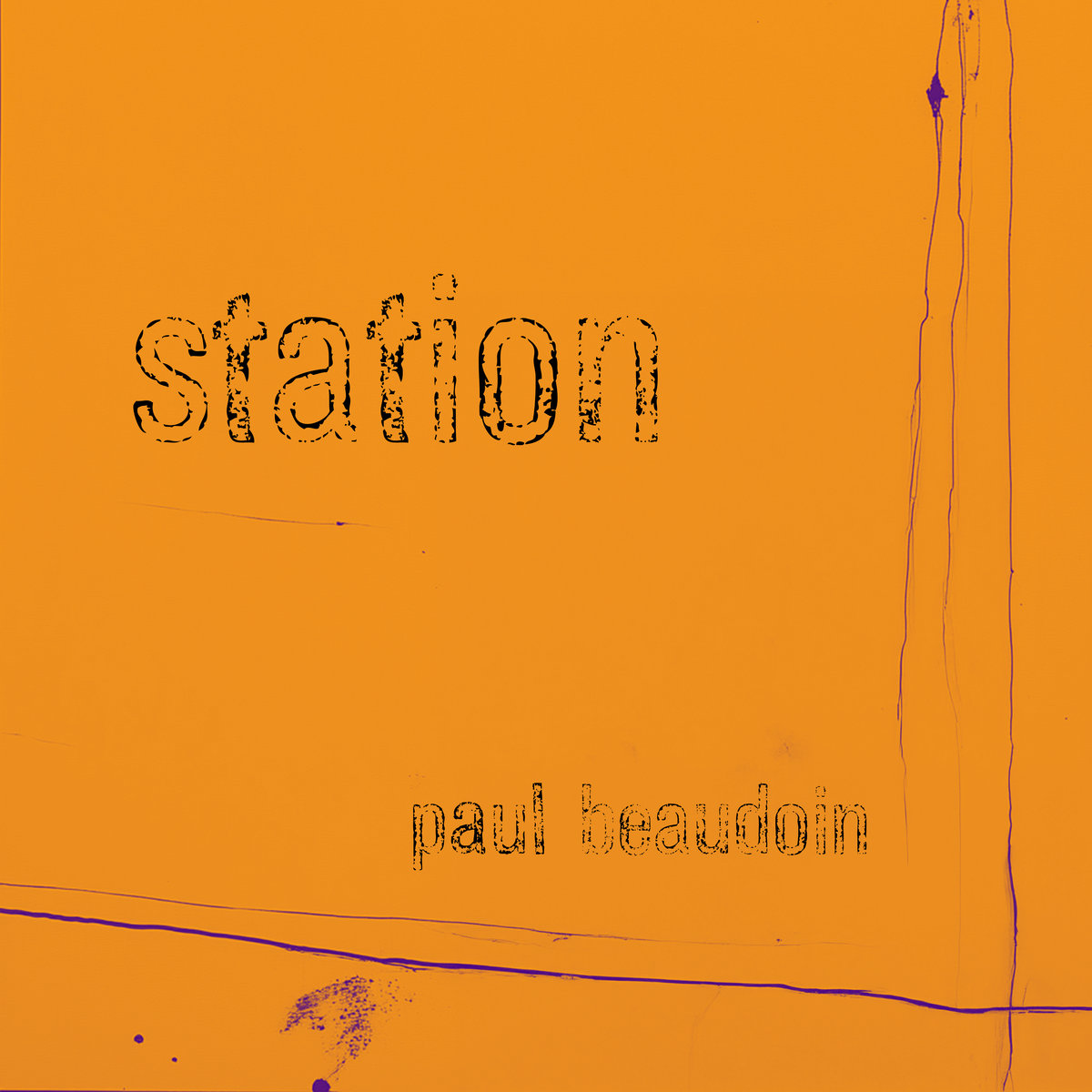
[1. IDEA]
■ The A. O.: The track from “station” that we prefer is “they all agreed, it was harmonic evidence”. Can you tell us how it came to light?
► Paul Beaudoin: For the past year, I’ve traced how sound holds memory—personal, cultural, and inherited—and how those memories can be altered, overwritten, or erased. While I work across media—painting, text, and video—sound feels uniquely attuned to the workings of memory. Most of us experience sound in sequence, gathering what comes forward while continually referring. Retrospectively. It’s a remarkable human act.
My earliest sonic memory is the piano. My mother aspired to be a cocktail lounge pianist in the 1950s and 60s. After school, she’d gather us to sing while playing a familiar rotation of classical and popular music. That daily, participatory listening shaped how I understand music. The piano was the first instrument I “learned”—not through formal lessons but through experimentation. I still remember plucking a string too hard and snapping it in half. That accident stayed with me, not only because of the sound, but also because it sparked my impulse to explore the instrument physically, conceptually, and emotionally.
station is a collection centered on memory and trace. Each track is a “station”—a place or time where something sonically residual remains. they all agreed, it was harmonic evidence draws from childhood music and my earliest encounters with music theory around age 15. That’s when I began composing seriously, fully immersed in theory—an obsession that lasted through my PhD dissertation on a Beethoven cello sonata. (So yes, I suppose you could say I’m legally obligated to find harmony wherever I go.)
My music isn’t linear; it rejects the formal narratives many listeners expect. This shift toward non-narrative listening came from conversations with John Cage. He taught me to hear sound not as a path but as an environment—something we enter, inhabit, and exit without hierarchy. I was especially drawn to his idea that each sound is a living object, a notion he borrowed from painter Lyonel Feininger, who believed every line or form had an independent life. That idea stayed with me. It changed how I hear, compose, and remember.
The phrase harmonic evidence holds several meanings. It nods to early theory lessons—the desire to name, analyze, and prove—but also points to sound itself as a form of evidence: a rarely accepted proof, yet deeply tied to memory. The track layers these tensions—between analysis and emotion, structured harmony and personal trace. I think of it as a sonic self-portrait: part archive, part analysis.
[2. CREATION]
(more…)○ Sep 2025 | Label: Independent
■ Genres: Ambient / Electroacoustic
■ Rating: 7.8/10
■ Favorite track: “Footprints“
► This is a weightless dream. We move seamlessly between the tonic and subdominant major chords in a vast atmosphere, that feels both intimate and infinite. Each moment dissolves delicately into the next, reminding us that beauty still exists and asks no questions.
○ Oct 2025 | Label: Passed Recordings
■ Genres: Ambient / Electronic / New Age
■ Rating: 7.0/10
■ Favorite track: “RainSong“
► We feel like we are listening to an acoustic reproduction of Penelope’s canvas. The fascinating choice of harmony is woven together and moves back and forth like a single wave, which arises and dissolves in itself with geometric rigor.

[1. IDEA]
■ The A. O.: The track from “Limbic Atlas” that we prefer is “Lirae”. Can you tell us how it came to light?
► Eir Drift: This is the first piece I made for the Limbic Atlas album. Lirae was ultimately born spontaneously even though it was the result of a long reflection on how to approach ambient composition. My goal was to merge the illustrative music I’ve been working on for years with a minimalist ambient format built around slow progression. Cinematic composition, for me, is about crafting a build-up that tells a story — with a beginning, a sense of tension, and a resolution. The idea was to experiment with that kind of narrative structure in a very slow ambient appropriate progression. I started with a suite of 4 piano chords that I wanted to be both tense and ethereal; I then transcribed, looped and slowed everything down in a sequencer… I had this ambient bass sonic base with a gradual build that you could get lost in and dream within. From there, I added textured layers and smooth one note drone to emphasize the transitions and builds. In the end, “Lirae” runs 16 minutes and holds a surprisingly introspective, experimental dimension that I hadn’t entirely anticipated.
[2. CREATION]
(more…)
[1. IDEA]
■ The A. O.: The track from “Seven types of silences” that we prefer is “VII”. Can you tell us how it came to light?
► Marko Josipović: That track came to be similarly like all the other ones of the album. I found a motif or a melody on the guitar, then I would sit with it for some time, and the composition/arrangement would very naturally reveal itself through that. I often work very sporadically and like to jump from idea to idea, but this album unfolded quite linearly, so the piece had a “definitive” feel whilst making it. I remember I wanted it to feel like a forceful emergence from the sea, violent, but also purified at the same time, leaving just enough space for the things to come. That tension between violent transformation and a kind of subtle holiness is what I intended to run through the whole album. The imagery of water and sea also played a big role in how I shaped the sound of this album in general.
[2. CREATION]
(more…)○ Jun 2025 | Label: Independent
■ Genres: Ambient / Drone / Noise
■ Rating: 7.5/10
■ Favorite track: “they all agreed, it was harmonic evidence“
► Distant noises flow like wind through empty corridors. Amid this abstract backdrop, the piano emerges—fragile, slow, and emotionally resonant—carrying a sense of longing and memory. Everything evokes a dreamlike tension, as if recalling something lost in time.

[1. IDEA]
■ The A. O.: The track from “Blue Radiance” that we prefer is “A Vast Profound”. Can you tell us how it came to light?
► Natas Kunas: Good pick! It was actually the very first track made for the album. I had just quit my day job and arrived at a month-long residency in rural Estonia. Filled to the brim with emotions I started playing and condensed that fleeting moment into “A Vast Profound”. Nearly all of it was done on a portable modular synthesizer, using four voices (parts), with great focus on tonal quality and additional layering of the same, but differently processed/altered tracks. During that month in Estonia I did almost the entirety of the album.
[2. CREATION]
(more…)
[1. IDEA]
■ The A. O.: The track from “Materia Vibrante” that we prefer is “Mundus Imaginalis”. Can you tell us how it came to light?
► Susana López: Both Materia Vibrante (the album) and Mundus Imaginalis are products of a very particular period in my life, a period marked by an existential crisis. It’s almost as if all the tracks could be combined into a single piece, sharing a common emotional core, instrumentation, and mental state.
Mundus Imaginalis is inspired by that intermediate dimension that connects the intelligible with the sensible: the imaginary world, where vision and vibration merge, according to Henry Corbin and Ibn Arabi. The most notable feature of this track is that it is made almost entirely with my “sonic triangle”, a sound object that I built several years ago. It is the physical element that initiates the vibration.
[2. CREATION]
(more…)○ Jun 2025 | Label: Independent
■ Genres: Drone / Ambient / Electronic
■ Rating: 8.1/10
■ Favorite track: “Chapter“
► This track unfolds like a slow sunrise. The harmonic path is built around resonant chords that radiate introspection and depth. The pacing is deliberate, allowing every passage to breathe fully, evoking feelings of calm, quiet wonder. A precious listening.

[1. IDEA]
■ The A. O.: The track from “Nocturnal Reverie” that we prefer is “Sewer Sea”. Can you tell us how it came to light?
► Risbo Tazeg: I wanted to create an album that could be a film soundtrack but without being connected to an actual film. I wanted it to be really evocative, to have strong – but abstract – narrative components.
Sewer sea in particular involves improvisation sessions. I started with one layer of synth, and made a 10 minutes long drone-like track. I had no plan in mind, just wanted to play. I then added a 10 minutes layer of cello on top of this drone. Listened to the whole and got rid of some parts of the cello. I did the same with another synth, listened, carved.
I repeated the whole process several times with several synths, with the cello and another string instrument. There has been quite a lot of editing and I don’t think there is anything left from the first 2 layers but somehow the structure that emerges organically from the first few improvised sessions is still there.
The rest of the album has been planned a bit more in advance, but for Sewer Sea I would just play, observe the outcome, edit, repeat. Layering and carving.
[2. CREATION]
(more…)