Voices #27
◦ “voices” is the place where we ask, artists reply and you read.
here we got:
Paul Beaudoin
answering some questions. We have already observed his ambient / drone / noise work here.
[1. IDEA]
■ The A. O.: The track from “station” that we prefer is “they all agreed, it was harmonic evidence”. Can you tell us how it came to light?
► Paul Beaudoin: For the past year, I’ve traced how sound holds memory—personal, cultural, and inherited—and how those memories can be altered, overwritten, or erased. While I work across media—painting, text, and video—sound feels uniquely attuned to the workings of memory. Most of us experience sound in sequence, gathering what comes forward while continually referring. Retrospectively. It’s a remarkable human act.
My earliest sonic memory is the piano. My mother aspired to be a cocktail lounge pianist in the 1950s and 60s. After school, she’d gather us to sing while playing a familiar rotation of classical and popular music. That daily, participatory listening shaped how I understand music. The piano was the first instrument I “learned”—not through formal lessons but through experimentation. I still remember plucking a string too hard and snapping it in half. That accident stayed with me, not only because of the sound, but also because it sparked my impulse to explore the instrument physically, conceptually, and emotionally.
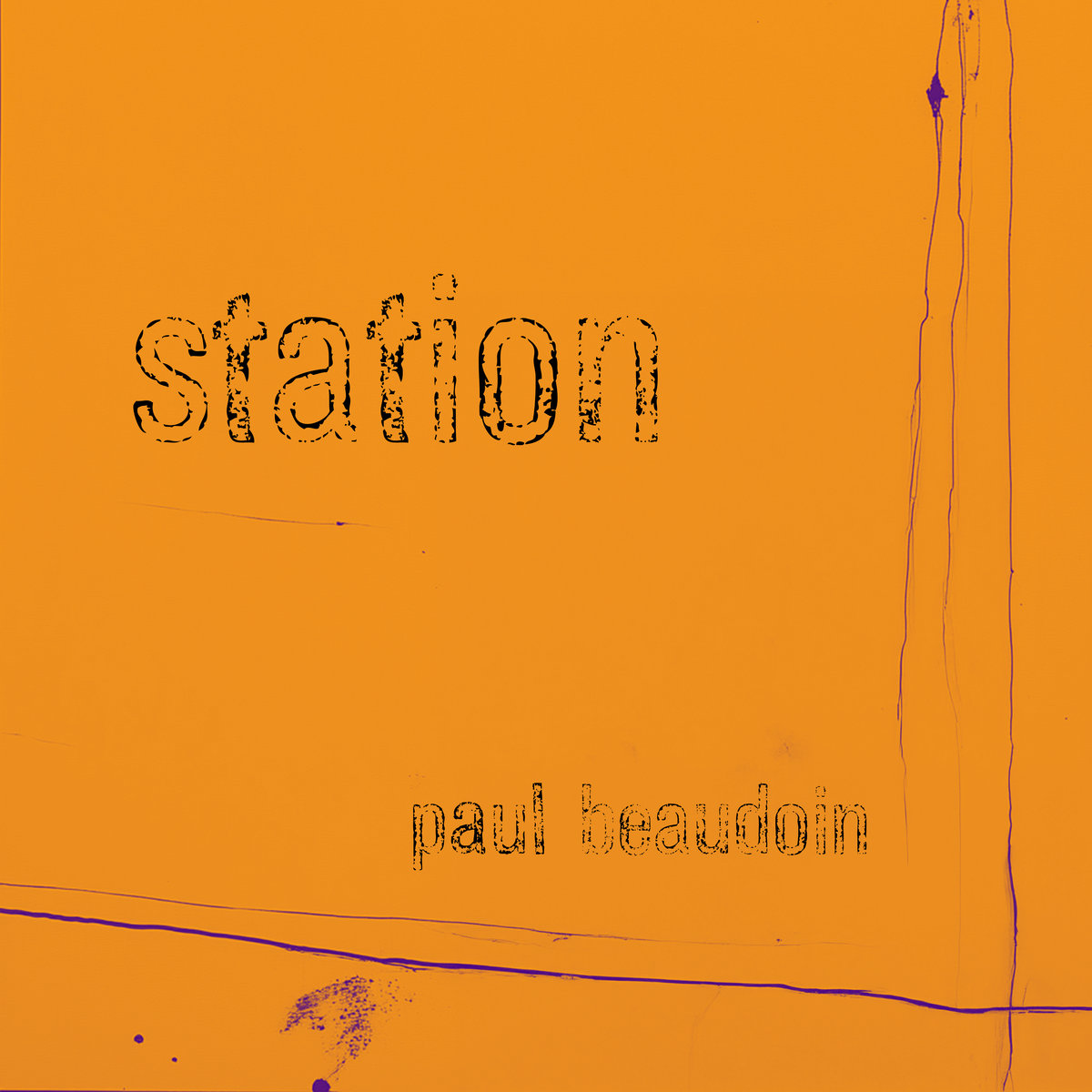
station is a collection centered on memory and trace. Each track is a “station”—a place or time where something sonically residual remains. they all agreed, it was harmonic evidence draws from childhood music and my earliest encounters with music theory around age 15. That’s when I began composing seriously, fully immersed in theory—an obsession that lasted through my PhD dissertation on a Beethoven cello sonata. (So yes, I suppose you could say I’m legally obligated to find harmony wherever I go.)
My music isn’t linear; it rejects the formal narratives many listeners expect. This shift toward non-narrative listening came from conversations with John Cage. He taught me to hear sound not as a path but as an environment—something we enter, inhabit, and exit without hierarchy. I was especially drawn to his idea that each sound is a living object, a notion he borrowed from painter Lyonel Feininger, who believed every line or form had an independent life. That idea stayed with me. It changed how I hear, compose, and remember.
The phrase harmonic evidence holds several meanings. It nods to early theory lessons—the desire to name, analyze, and prove—but also points to sound itself as a form of evidence: a rarely accepted proof, yet deeply tied to memory. The track layers these tensions—between analysis and emotion, structured harmony and personal trace. I think of it as a sonic self-portrait: part archive, part analysis.
[2. CREATION]
■ The A. O.: How do you usually approach composition? Do you start with a concept, a sound, a state of mind or what else? How do you generally proceed from the initial seed to the complete work?
► Paul Beaudoin: I’m fortunate to work full-time as an artist. I don’t wait for inspiration—I get up and work every day. A new piece can start anywhere: something read or overheard, a visual fragment, a memory, even a line from social media. The source matters less than the commitment to stay with the work—to shape, refine, and listen like a sculptor clearing detritus to reveal what’s essential.
For many years, I worked within academic composition and analysis. Over time, I moved away from pre-compositional systems toward something more intuitive, porous, and embodied. In a way, I had to unlearn what I had mastered. There’s that old story: once you’re Beethoven, you can break the rules.
Now, I listen more and plan less. I might start with a concept or loose structure, but just as often, I discover connections after the fact—grouping works composed over months and seeking the subtle threads that bind them. That’s when real joy starts – giving titles to tracks, shaping a release, and letting the work reveal what it’s been doing all along.
[3. FEEDBACK]
■ The A. O.: What do you hope listeners feel or experience when engaging with your music?
► Paul Beaudoin: For me, a work of art is never complete until it enters someone else’s consciousness.
Whether sound, painting, photography, video, or text, the work’s final dimension unfolds through the listener’s or viewer’s experience.
I had the privilege of knowing John Cage personally, and his thinking still shapes my approach. His radical openness—to the sounds already present, to indeterminacy, and to refusing fixed meaning—taught me that the artist does not give meaning. It is a space of encounter, dialogue, and discovery.
We each carry unique histories, sensitivities, and emotional landscapes.
My anger, love, and fears will not—and should not—register the same way in anyone else. That’s not a flaw in the work; it’s the possibility I want to protect. I don’t expect others to experience the work in the same way I do.
Instead, I create space where each listener or viewer can enter with their subjectivity and complete the work in their way. This approach requires humility and trust from both the artist and the audience alike. It invites us to embrace uncertainty and multiplicity. It invites listening. My practice is as much about witnessing as it is making. It’s a continuous exchange, a shared vulnerability, a mutual creation.
[4. IDENTITY]
■ The A. O.: In a world saturated with digital music content, how do you try to keep your sound distinct and personally meaningful?
► Paul Beaudoin: In a world flooded with digital music, maintaining a distinct and personally meaningful sound is a complex challenge. I don’t deny that I seek recognition; like many artists, I sometimes feel under-recognized. However, over time, I’ve learned that the core of my work must stem from an intense, authentic emotional perspective—one that remains steady, regardless of genre or medium.
As a composer affiliated with the Wandelweiser collective, my practice is characterized by silence, patience, and attentiveness. These values shape how I listen and respond to sound. This approach creates a contemplative space where meaning unfolds slowly and organically, rather than being dictated by trends or applause.
My spiritual practice also informs this process. Creativity, for me, is a spiritual act—a devotion requiring sincerity, discipline, and surrender to something larger than the ego. Whether composing sound, painting, or writing, I approach each with intensity and openness, aiming for a connection that transcends the individual.
While I hope others find and respond to my work, validation can be affirming—my deepest motivation is to create something I can live with honestly and thoroughly.
This commitment to personal truth, rooted in my artistic lineage and spiritual practice, enables my work to maintain its distinctiveness and meaning in a crowded digital landscape.
[5. INFLUENCES]
■ The A. O.: Mention 3 albums that you consider relevant to your musical path and why.
► Paul Beaudoin: Having composed for nearly fifty years, my list of influential albums is vast and evolving, reflecting the organic nature of my impulses. If I had to pick three right now, they would be:
○ Pierre Boulez conducting Stravinsky’s Le Sacre du Printemps (1966, Orchestre National de la R.T.F., Nonesuch Records)
Like many composers, Stravinsky’s Rite of Spring was foundational for me. This recording may not be the most famous, but I return often because, despite its dense orchestration, every instrument remains audible. It sharpened my micro-listening and deepened my attention to sonic detail.
○ Celer – Nature Chamber 1–4 (Self-released)
Will Long, who records under the name Celer, has been a role model for years. His long, spacious soundscapes coalesce into immersive experiences. This three-hour work intricately weaves Arnold Schoenberg’s music with field recordings, including dripping water, cave acoustics, and voices from Yamanashi’s caves. Celer’s catalog is vast, and many albums represent his style, but this one exemplifies his seamless merging of composition, sampling, and environment.
○ Towering Inferno – Kaddish (TI Records / Island Records)
I found this album in a Tower Records close-out bin in New York in the 1990s, drawn by its cover. I was unprepared for its sonic impact. It flirts with banality in a profoundly postmodern way, blending Eastern European folk singing, heavy metal guitar, klezmer violin, ambient textures, and sampled voices. Brian Eno called it “the most frightening record” he had ever heard. Tragically, Richard Wolfson, half the group, died before the second project. Kaddish remains an extraordinary, haunting experience.
[6. REGARDS]
■ The A. O.: Leave us with a quote you love.
► Paul Beaudoin: I spent decades teaching art and music at the university level. Along the way, I realized I had some misguided ideas about making art. I had an epiphany reading Steven Pressfield’s The War of Art. Here are my words:
Don’t try to please your teachers, your public, or impress friends and neighbors.
Don’t make art to prove you’re a genius, a misunderstood giant, or to get laid.
Make art you love, that you want to live with, and that brings you peace.
If you’re lucky—and I mean lucky—others will find and respond to it.
But be warned: their response isn’t a validation of who you are.
For that, yes—be a good person.